
Cracked Teeth
Cracked teeth are increasingly common and can affect both teeth that have previously undergone root canal therapy and those that have not. A crack begins as a small opening in the crown or root, and if it extends inward, it may compromise the tooth and lead to infection.
At Advanced Endodontics Center, Dr. Burgdorf uses advanced 3D imaging and microscopic examination to precisely evaluate the depth and extent of a crack. This allows for a thorough assessment and a treatment plan tailored to the unique needs of each patient. Depending on the severity and location of the fracture, treatment may include a protective crown, root canal therapy, endodontic microsurgery, or extraction.
Timing is critical in the management of cracked teeth, as structural integrity can deteriorate over time, increasing the risk of tooth loss. If you are experiencing discomfort or your dentist has identified a crack, we invite you to contact our office to schedule a consultation. Our team will provide a careful, personalized evaluation and guide you toward the most conservative and effective treatment. Please contact our office for further details!
Types of Cracks
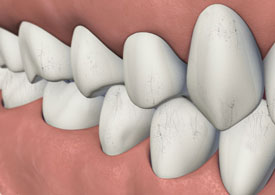
Craze lines
These are tiny cracks that only affect the outer enamel of the tooth. These cracks are more common in adults. These types of cracks are superficial and are usually of no concern.
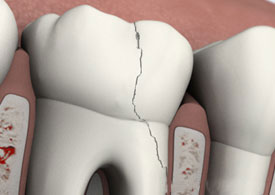
Fractured Cusp
When a cusp becomes weakened, a fracture may result. The cusp may break off or be removed by a dentist. A fractured cusp rarely damages the pulp, so root canal is not necessary. Your dentist will usually restore the tooth with a full crown.
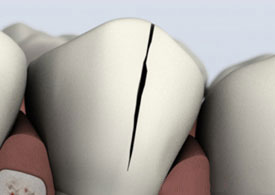
Treatable Cracked Tooth
This type of crack extends from the chewing surface of the tooth and vertically migrates towards the root. In some cases, the crack may extend below the gum line. It is possible for the crack to extend further into the root. Damage to the pulp is commonplace. In this case, root canal treatment is usually necessary. A cracked tooth that is not treated will worsen, resulting in the loss of the tooth. Therefore, early detection is essential.
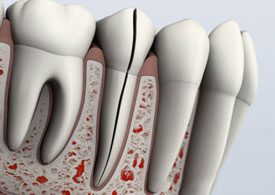
Split Tooth
A split tooth is usually the result of an untreated cracked tooth. It can be identified by a crack with distinct segments. This type of tooth can never be saved intact. Yet, the position and extent of the problem will dictate whether any portion of the tooth can be saved. Sometimes, endodontic retreatment by the doctors and restoration by your dentist can be used to save a portion of the tooth.
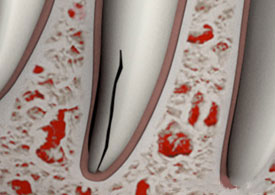
Vertical Root Fracture
A vertical root fracture begins at the root and extends towards the chewing surface of the tooth. Unfortunately, they show minimal symptoms and may go unnoticed. Treatment involves endodontic surgery if a portion of the tooth can be saved by removal of the fractured root. Otherwise, the tooth will have to be extracted.